Tuesday, May 30, 2006

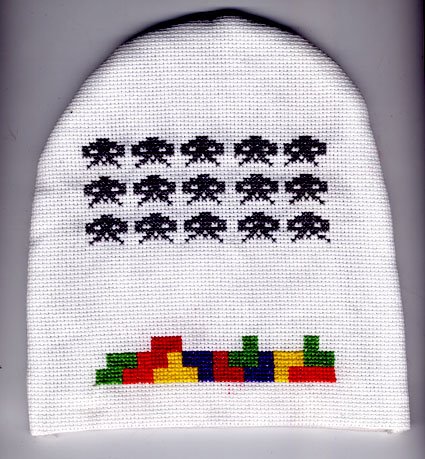
Game Boy Cosy. Niki Bywater. 2005


Cross stitch on fabric. 6in. x 7in.
It's hard to believe now but once upon a time the Game Boy was at the cutting edge of technology. Niki has devised a cross-stitch (old tech meets new tech) 'cosy' to cover the machine after a hard day's gaming. She also made a pair of black thumb covers embellished with white Space Invaders, to wear whilst playing. Niki went on to study Textile Design at Goldsmiths.

Perfect Woman. Tina Viljoen. 2004


Glass, laytex, resin, laboratory stand and shoes. 60in. x 10in. x 8in.
Tina put this sculpture together whilst looking at male perceptions of female worth. The lips and breasts are made from latex, the lab bottle represents the uterus and the feet have been cast in clear resin.

Chandelier. Mariko Hatorri. 2005


Metal rings and re-cycled drink cans. 17in x 9in.
Mariko works only with re-cycled materials. Before joining the Access course she worked on art projects with villages in Africa. Resources were poor and so everything they used was recycled; she continued this methodology when joining the programme. The chandelier pictured was made from found drinks cans.

Lemanga. Sophie Avgousti. 2005


Photograph of friend, digitally transformed into a 'Manga' character. One from a series of six.
In response to work on the theme 'Japan' Sophie started to look at Manga drawing techniques. After mastering the style she felt it was too ubiquitous and decided to take her work in another direction. She photographed a number of friends and using Photoshop turned them into Mange/Anime type characters. The eyes and chin work especially well.

Hotel. Mark Hadley. 2005


Ink and bleach on canvas. 11in. x 16in.
During the early part of the course, as part of the art & design basic skills students learn a range of mark making techniques. One of these is painting bleach onto black ink to achieve an effect. Bleach on wet ink creates a diffuse, abstract result and on dry ink a more controlled, drawn finish. Later in the course Mark chose to specialise in illustration and utilised these techniques further. He made a set of drawings of London hotels, photocopied them and cut away all the windows. This was then glued onto canvas and ink and bleach were painted over where the windows had been removed. Coloured inks were applied to complete the illustration.

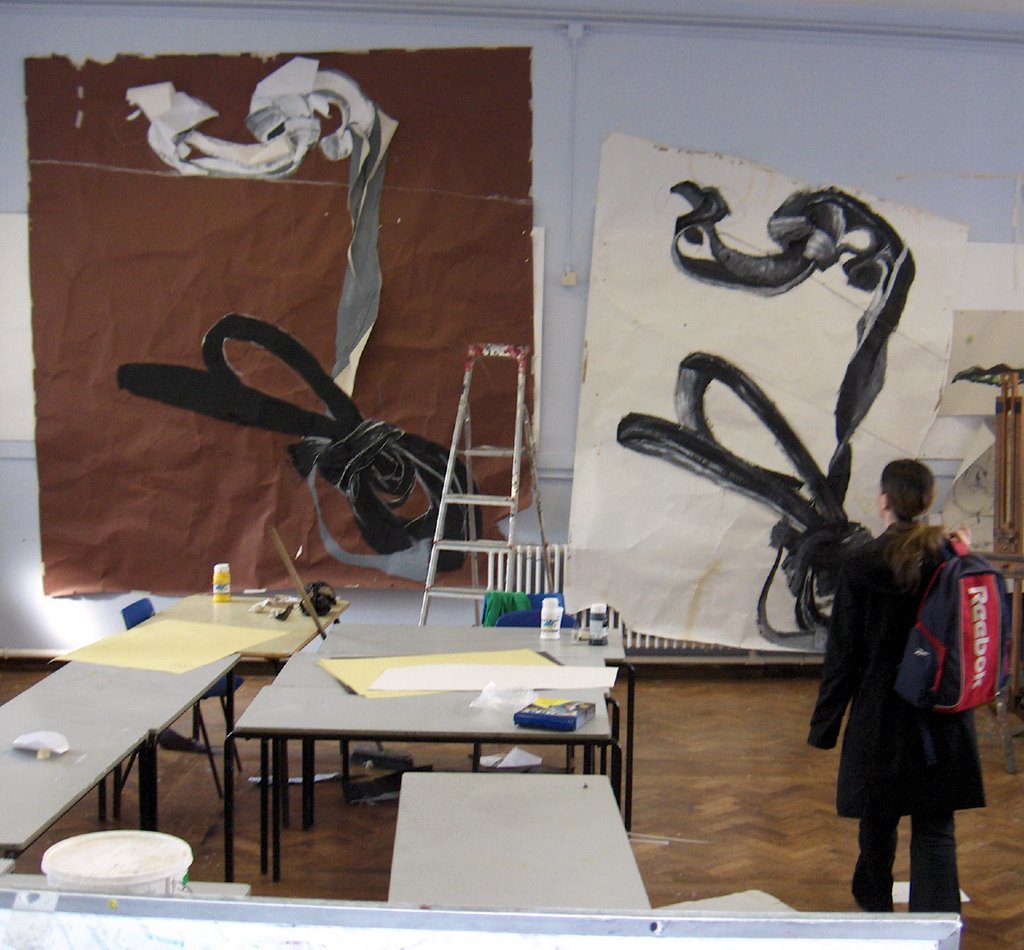
Knot. Finnula Campbell. 2005


Acrylic, chalk, charcoal and montage on paper. 96in. x 72in.
During a visit to the British Museum Finnula became interested in the intricate knots that joined samurai swords to the wearers' belts. These were recorded in detail in a sketchbook and developed in the studio. She chose to represent them on a huge scale using black paint and an extra large brush, creating swirling almost calligraphic shapes. Other pieces built out from the picture surface using card and paper resulting in a frieze/sculpture-like effect.

Tuesday, May 16, 2006

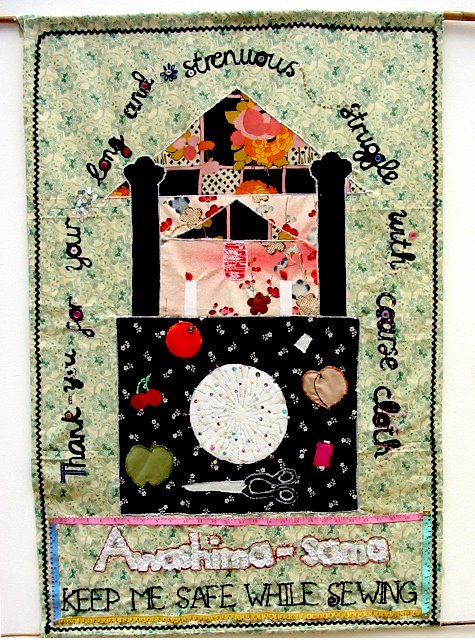
Thank You for Your Long and Strenuous Struggle with Coarse Cloth. Elizabeth Cake. 2005


Applique on fabric wall hanging. 48in. x 36in.
Whilst investigating Japanese religion, Elizabeth discovered that thousands of different gods were worshiped. She became especially interested in 'Awashima-Sama', the goddess of sewing. Research told her that every year ladies gather at a shrine to the goddess and present her with thimbles and needles, whilst saying things like 'Keep me safe whlle sewing' and 'Thank you for your long and strenuous struggle with coarse cloth’. This hanging is a tribute to her. Elizabeth went on to study Textile Design at Goldsmiths.

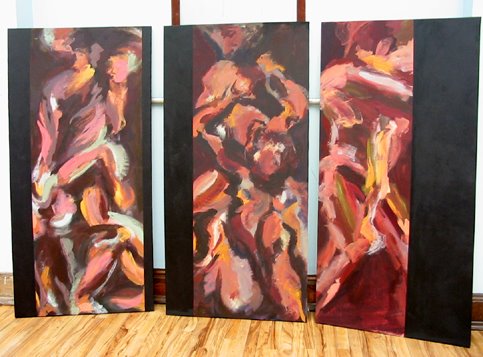
Tryptich. Lucy Crispin, 2005


Acrylic on canvas with sketchbook. 72 in. x 96 in.
Set of three large canvases based on an abstracted version of Rodin sculptures. This shows the importance of using a sketchbook, not just as a research tool but also a way of working through ideas and techniques.

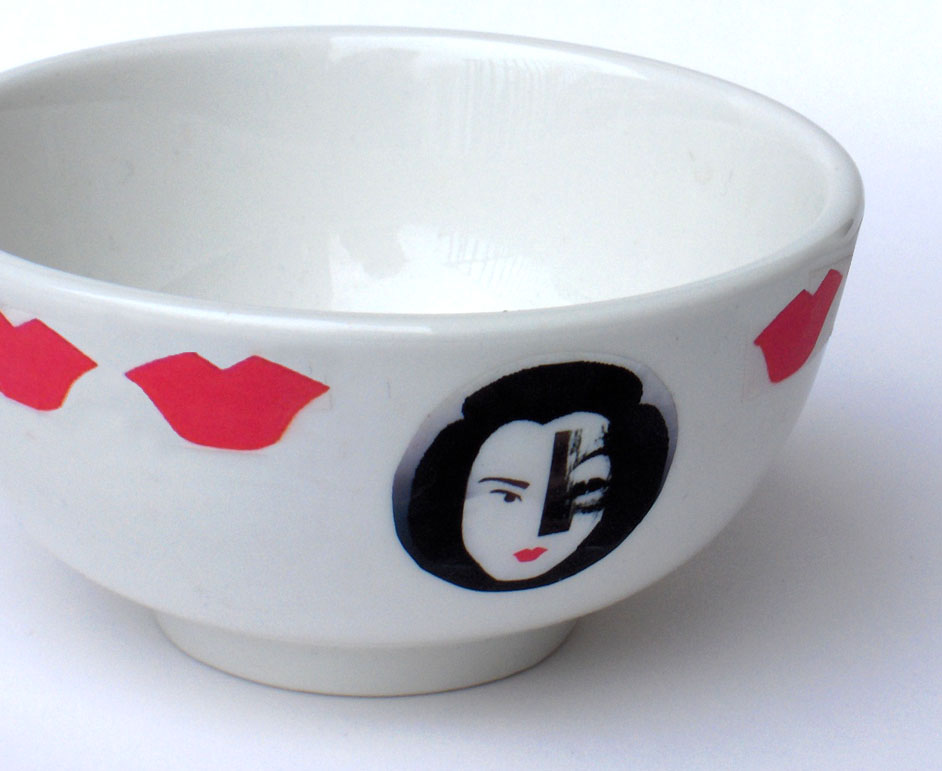
Bowl, Phoebe Allen. 2005


Ceramic bowl and Lazertrran. 5in x 3 in.
Phoebe was a graphics student who through this work demonstrates our philosophy of breaking down the walls between disciplines. Working on a bowl is as valid for a graphic designer as it is for a ceramicist. For her major project Phoebe silk-screened a huge poster for an imaginary Japanese horror film. She then produced a press pack for the Oscar ceremonies consisting of poster, set of badges, plastic ID card and Japanese tea bowl. The face on the bowl was taken from the original poster and the lips from the face image. These were printed onto water based decal transfer paper and transferred onto the bowl.

Monday, May 15, 2006

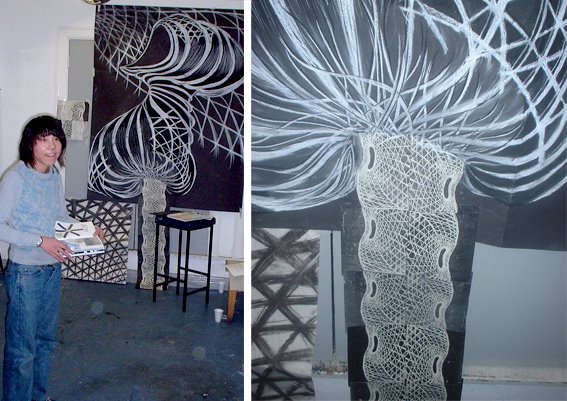
Yumi describes how she was inspired by the roof at the British Museum to create this drawing (+ detail of drawing). 2004


Charcoal, chalk and relief print on paper. 3 metres x 1.5 metres
We sent students to the British Museum to draw the statues but Yumi had different ideas. She had never been there before and was captivated by the dome over the courtyard; she spent the day drawing it. Back in the studio she produced a series of relief prints and large abstracted drawings.

Monday, May 08, 2006

Recipe Cards for Spiders. Sigita Zivoltaite, 2004


4 double sided recipie cards from a set of 10. Pen, ink, acrylic paint, metallic paint and collage. 21cm x 14.5cm each
As part of a graphics/illustration specialist project, students were asked to design a set of double-sided recipe cards and a wallet to contain them. They were encouraged to move away from lasagna and produce something more creative. Sigita decided spiders had been overlooked in the recipe card department and produced a set of cards targeting the arachnid market. Each of the set of 10 featured a hand crafted image on the front and recipes containing aphids cooked in dew etc on the back. This worked well and adhered to our graphic design philosophy where the computer is only one tool amongst many for generating responses to a brief.

'Access All Areas'. Group Exhibition. 2004


Paintings and sculptures exhibited as part of show at the New Gallery, Swiss Cottage, 2004.

Deadhead. Lucy Crispin. 2004


Acrylic paint on canvas. 250cm x 150cm
Students were asked to produce a body of work connected to ideas about 'Food'. Lucy's approach was to investigate those parts of the animal that are not used for human consumption and spent many happy hours touring the butcher’s shops of Hackney taking photographs and making drawings. When she returned to the studio she embarked on a series of paintings about the heads of dead animals (called 'Deadheads'). This one is a chicken; it was the first time she had painted on canvas.

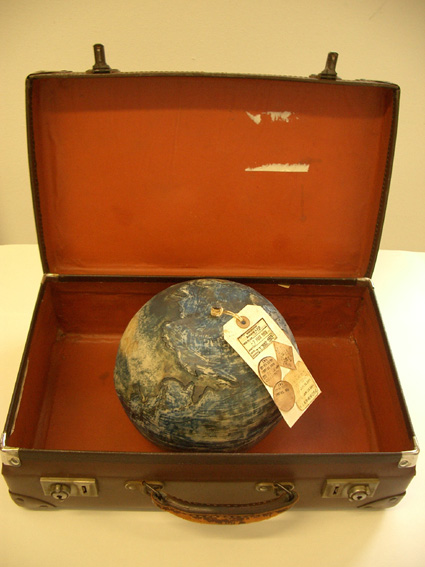
World in a Suitcase, Maki Kita, 2004


Suitcase, ceramic globe, luggage tag and passport stamps. 85cm x 50cm x 80cm.
A lot of Maki's work is about travel and borders, both real and artificial. This piece is a ceramic globe with travel tag, displayed in a found suitcase.